Autumn Skincare
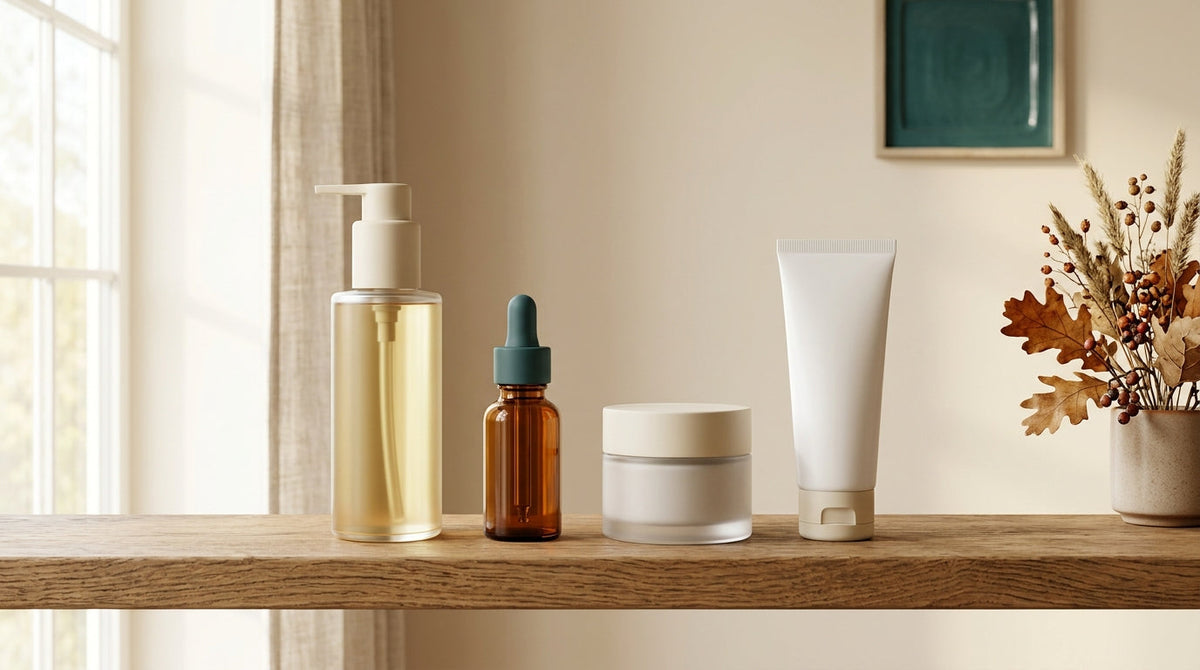
Quick answer: A minimum effective autumn reset routine has four steps applied in this order: cleanse, treat with a targeted serum, moisturise, and finish with SPF in the morning (or leave SPF out and go straight to bed at night). The core rule for layering is thinnest to thickest consistency, so watery serums go on before richer creams, and SPF always goes last as your final morning step. Keeping to four steps, done consistently, tends to deliver better results than a ten-step routine followed inconsistently.
What is the minimum effective skincare routine?
A minimum effective routine is the smallest set of steps that reliably supports healthy-looking skin without unnecessary complexity:
- Cleanse — removes the day's build-up of oil, sunscreen and environmental residue so subsequent products can work properly.
- Treat — a serum targeted to your main concern, whether that's vitamin C for antioxidant support, niacinamide for an even-looking complexion, or retinol for supporting texture and fine lines.
- Moisturise — locks in hydration and supports the skin barrier.
- Protect — SPF, against the cumulative UV exposure that's widely recognised as a leading driver of visible skin ageing.
Beyond these four, everything else — exfoliants, eye creams, masks, additional serums — is a worthwhile addition once the basics are consistent, not a substitute for them. Trying to run a ten-step routine before the fundamentals are locked in usually leads to inconsistency, irritation, or both. If you're rebuilding your routine this autumn and want it kept simple, our ZO programs and kits are built around this same principle: a curated set of essentials rather than an overwhelming list.

What order should I apply my skincare products?
The general rule is to apply products from thinnest, most watery texture through to thickest, richest texture, finishing with SPF as the last step each morning:
- Cleanser first, to start with a clean base.
- Water-based treatment serums, such as vitamin C or niacinamide.
- Thicker treatment products like retinol, usually reserved for the evening.
- Moisturiser, to seal everything in and support the barrier.
- SPF sunscreen — mornings only, as the very last step before makeup or leaving the house. In the evening, moisturiser is the final step instead.
A simple way to remember the order is that each product should be able to penetrate the skin without being blocked by a heavier layer applied before it — which is why sunscreen, a physical barrier against UV, always goes last, and why lightweight serums come before rich creams rather than after. If you're combining actives such as retinol with hydrating or barrier-supportive products from our barrier repair or hyaluronic acid ranges, applying the hydrating layer after the active can also help reduce the chance of irritation.
A reliable four-step routine, applied in the right order and kept up consistently, is the most sensible foundation for an autumn reset. If you'd like help choosing products or building this out further, our consultation service is a good next step.
Educational content only — not medical advice. If a product causes persistent irritation, stop use and consult a GP or dermatologist.

Dr. Tanveer Ahmed
MBBS/FCPS · Founder & Clinical Director, Celsia Skin
MBBS/FCPS · Founder & Clinical Director, Celsia Skin
Was this content helpful?
Thank you for your feedback — it helps us improve.
Good to know
Frequently asked questions
What are the minimum steps needed in a skincare routine?
A minimum effective routine covers four steps: cleanse, treat with a targeted serum, moisturise, and protect with SPF in the morning. This covers the essentials without unnecessary complexity.
What order should I apply skincare products in?
Apply from thinnest to thickest texture: cleanser, then water-based serums, then treatment products like retinol (usually at night), then moisturiser, with SPF always applied last each morning.
Do I need more than four products for good results?
Not necessarily. Extras like exfoliants, eye creams and masks can be worthwhile additions once the basics are consistent, but a simple routine followed reliably tends to outperform a complicated one used inconsistently.
Why does SPF always go last in the morning?
Sunscreen works as a barrier against UV, so it needs to sit on top of your other products rather than be blocked by a heavier layer applied afterwards.
How do I combine retinol with hydrating products safely?
Applying a hydrating, barrier-supportive product after retinol can help reduce the chance of irritation. If you're unsure how to combine your specific products, a consultation can help you build a suitable order.